Om ॐ: The Sound Before Sound — Origin, Meaning, and How to Chant It
Reading Time: 9 Minutes
Close your eyes at the start of almost any yoga class, meditation circle, or Vedic ritual anywhere in the world, and you will likely hear the same sound rise into the room: a long, low Om (also written Aum). It's the most recognisable syllable in the entire yogic and Hindu tradition — printed on t-shirts, tattooed on wrists, carved into pendants. But long before it became a symbol, Om was understood as something far more specific: not a word that means something, but a sound that is something — the vibration said to underlie all of creation.
This article traces Om back to its philosophical roots, explains what the syllable is actually believed to represent, and walks through how to chant it correctly — technically and intentionally — so that it does more than decorate a yoga mat.
What Om Actually Is
Om is technically not one sound but three, fused into one continuous utterance: A-U-M. In Sanskrit phonetics, these three sounds are said to move through the entire range of the human vocal apparatus - from the back of the throat (A), through the middle of the mouth (U), to the lips closing (M). A-U-M is thought to contain the entire spectrum of possible vocal sounds. Every syllable your mouth can shape lives somewhere inside those three letters. This is why it gets treated as a kind of acoustic totality. The seed everything else grows out of. Every other sound, every word, every name, every form you can point to - all of it is said to emerge from this one syllable first.
This is exactly why Om is called pranava - that which is sounded out or that which runs through breath, through prana. It's also called the bija mantra - the root seed-syllable. The one every other mantra is considered to branch from. We've actually gone deeper into what a mantra sadhana really means and how it's chosen for a practitioner, if that idea is new to you.
Philosophical Origin: From the Vedas to the Upanishads
Om's earliest appearances show up in Vedas (oldest layer of Hindu scripture) where it functions mostly as a ritual affirmation - chanted at start and close of Vedic recitation. A signal of agreement. Invocation. Completion. But its real philosophical depth doesn't come from there.
It comes later, from the Upanishads - the more speculative texts that stopped asking “how do we perform the ritual correctly” and started asking what's actually sitting behind the ritual, behind appearance itself. This is the same shift we trace in a lot of Vedic thought - where does a practice actually belong once you stop treating it as ritual alone; where does mantra sadhna belong if real yoga begins at breath. Two texts matter most:
The Mandukya Upanishad is entirely devoted to Om. It is short (only twelve verses) but is considered one of most important texts in Vedantic philosophy. Why, you ask? Because it maps a single syllable onto the entire structure of consciousness.
The Katha Upanishad and Chandogya Upanishad both describe Om as the sound-form of Brahman - the ultimate, formless reality behind the universe - and as a vehicle for reaching it. “This syllable is Brahman. This syllable is the highest.”
The Four States Mapped onto A-U-M
The Mandukya Upanishad's central teaching is that the three sounds of Om correspond to three states of consciousness — and that the syllable as a whole points toward a fourth, beyond all three:
A - waking state (jagrat), ordinary consciousness engaged with the external world.
U - dreaming state (svapna), consciousness turned inward, engaged with mental impressions.
M - deep, dreamless sleep (Sushupti), consciousness collapsed into a kind of undifferentiated rest, nothing moving through it
Silence after the sound. Turiya - the “fourth” state. Pure awareness itself, the witness sitting underneath waking, dreaming, sleep - present through all three, untouched by any of them.
This exact idea of witnessing awareness underneath everything shows up again once you get into practices like So Hum and Shivoham — worth a read if this article is resonating with you.
This is the real philosophical payload of Om: it isn't just a symbol for the absolute. Chanted correctly, it's meant to be a structured rehearsal of consciousness moving through every state it can occupy and arriving, in the silence at the end, at what is said to remain when all states are stripped away. The silence after the hum is not an absence — in this framework, it's the point.
Om as Symbol: Form Following Sound
The visual Om symbol - ॐ - used across Hindu, Buddhist, and Jain traditions is technically a Devanagari script rendering of the sound. But it's almost always read symbolically too. Large lower curve maps to the waking state. Upper curve, dreaming. Side curve, deep sleep. And crescent-and-dot floating above the whole thing represents turiya - silence, transcendence, sitting apart from and above the other three. Because it was never really a “state” in that same sequence to begin with.
How to Chant Om
Correct technique matters here in a very literal sense: the tradition treats Om as a physical practice as much as a mental one. The value is said to come partly from the vibration itself, so posture, breath, and pronunciation aren't formalities — they're the mechanism.
1. Sit with a straight, unsupported spine
A tall spine lets the sound resonate through the chest and skull rather than getting trapped or muffled. Cross-legged on the floor or upright in a chair - both work fine. What actually matters is that your spine stays elongated. Your chest stays open.
2. Inhale fully and slowly through the nose
Fill the lungs without straining. The chant is voiced entirely on the exhale, so the length of your Om is limited by the length of your breath, not the other way around.
3. Chant in three distinct phases on one continuous exhale
A (ah) — begin the sound open and low, from the diaphragm, letting it feel like it originates near the navel or solar plexus. Roughly 40–50% of the total breath.
U (oo) — let the sound roll forward, from the chest up through the throat, the mouth softening from "ah" toward "oo" as the lips gradually round. Roughly 30% of the breath.
M (mmm) — close the lips and let the hum resonate in the nasal cavity and crown of the head. This is usually the longest sustained resonance in the whole chant. Roughly 20-30% of the breath, tapered down to silence rather than cut off abruptly.
The transitions between A→U→M should feel smooth. Not like three separate syllables stapled together end to end. One unbroken glide, the way a slide whistle changes pitch without ever actually stopping.
4. Rest in the silence after the sound
This is the step most people skip. And it's arguably the entire point of exercise. Once the hum fades out, sit in the stillness for a few breaths before inhaling to begin again. That gap, right there, is where the “fourth state” turiya, is said to actually be accessible. Not in the sound itself. In whatever's left once the sound is gone.
5. Repeat
Traditional counts run 3, 9, or 108 repetitions - full mala. But even three rounds, done with real attention, will let you feel the difference between reciting Om and actually chanting it.
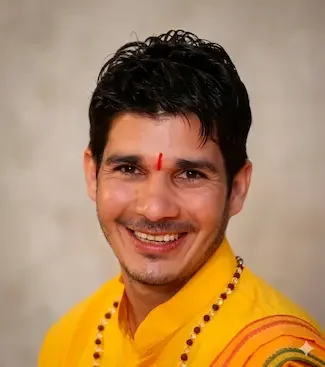
Manohar Ji, Ekattva Founder and Mantra Meditation Master, chanting Om.
Common Mistakes
Rushing the transitions: Treating A, U, and M as 3 quick, separate beats instead of one continuous vowel-shift loses the entire resonance-building effect this sequence was designed for in the first place.
Chanting from throat instead of breath: The sound should be powered by the diaphragm, riding out on a full exhale. Not pushed or forced from the throat which just produces a strained, thin tone that tires fast.
Skipping the silence. Ending abruptly and immediately inhaling for the next round turns the whole practice into repetition for its own sake, bypassing the exact stillness sound was meant to lead you into.
Pitching too high. A lower, chest-centred pitch generally builds more resonance, and it's simply easier to sustain across a long exhale than a high, thin one that runs out of air halfway through.
Why It's Still Chanted Today
Whether or not one takes the metaphysics of Brahman and turiya literally, Om persists - in yoga studios, meditation apps, and temples alike. Because the practice does something noticeable even at a purely physiological level: a long, slow, fully-exhaled hum naturally slows the breath, engages the diaphragm, and creates a vibration that's felt as much as heard. There's real neuroscience behind why this works (the science of mantra), not just tradition insisting it does - we've broken that down in more depth elsewhere. The philosophy gives that sensation a map; the technique is what makes the sensation available in the first place.
Chanted with attention to breath, resonance, and the silence that follows, Om is less a word you say and more a structure you move through — waking, dreaming, sleep, and what's left over when all three fall away.
Chanting Om FAQs
-
Yes. Om and AUM refer to the exact same sound. AUM is simply the more phonetically precise spelling, spelling out the three distinct sounds (A-U-M) that blend into the single syllable most people write as "Om."
-
Traditional counts run 3, 9, or 108 repetitions - a full mala. There's no strict rule for beginners. Though even three rounds chanted with real attention to breath and resonance are enough to feel the difference between reciting Om and actually chanting it.
-
Yes. While Om carries deep roots in Hindu philosophy, the physical practice - breath, resonance, stillness - works on a physiological level regardless of belief. Many practitioners approach it purely as a breath and sound practice. Without adopting any religious framework at all.
-
Both are valid and used in different contexts. Chanting aloud engages the physical vibration and resonance the tradition emphasizes. Which is why it's typically taught first. Silent, internal repetition - often called manas japa - tends to come later, once the felt sense of sound is already familiar.
-
Silence after the hum isn't incidental - in the Mandukya Upanishad's framework, that gap is where turiya, the “fourth state” is said to actually be accessible. Skipping it and moving straight to the next repetition bypasses exact stillness the sound is meant to lead into.
-
There are common mistakes worth avoiding:
Rushing the A-U-M transitions
Chanting from the throat instead of diaphragm
Skipping the silence
Pitching too high.
None of these are wrong in a moral sense. But they do reduce the resonance and stillness the technique is designed to build.
Chanting Om Mantra: Final Words
Chanting Om on your own is a genuine starting point. But on its own, it's still just one piece of a much larger architecture. In classical mantra sadhana, Om rarely stands alone; it's the seed other mantras branch from, opening and closing note of a much longer practice built around breath, sound, and sustained attention.
If you're ready to go beyond a single syllable and actually build that fuller practice - under real guidance, not a search engine tab, our Mantra Sadhana Suite is exactly where that begins!
Explore Vedic Mantra Yoga Retreats!
Do you chant Om at the start of your practice, the end, or both? And have you noticed a difference in how A-U-M vibrates with you depending on when you chant it? Share your experience in comment section below.