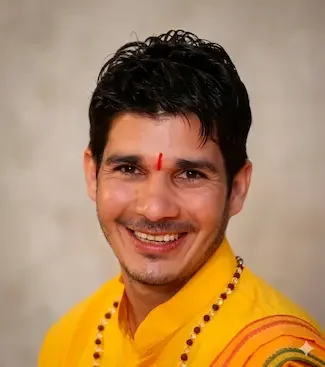
Why Real Yoga Begins at Breath: What My Years in the Parmarth Gurukul Taught Me
Reading Time: 10 minutes
For years, people have asked me the same question in different words - Manohar, what is real yoga actually? How is it connected to our breath? I always answer carefully. Choosing words that wouldn’t overwhelm someone standing at the edge of a practice that they just discovered. But the real answer? I carried back with me from my years in Gurukul at Parmartha Niketan Ashram in Rishikesh.
It is really simpler than most expect… And harder to accept. Real yoga doesn’t begin with body postures. It has nothing to do with pose, your playlist, or mat that you unroll quietly in the morning. It begins with your breath - the first thing we ever did and the last thing we will ever do.
Let’s explore this in detail today.
What Do You See When You Think of Yoga?
Close your eyes for a moment and let this word settle — Yoga.
What arrives?
I ask this question often - at the beginning of classes; in conversations with students who have been practising for years. The answers, almost without exception, reflect a familiar perception.
◈ A studio with warm lighting.
◈ A perfectly executed pose shared on social media.
◈ A playlist, a mat, a sequence of movements set to an encouraging teacher's voice.
◈ An elderly group laughing their lungs out in the community park, their hands rising and falling.
◈ An artfully curated quiet corner of home, with a Buddha or Nataraja idol or similar, accompanying crystals, and vapors drifting from incense.
For many, yoga is a Tuesday evening — a welcome hour of stretching before sleep, a breath of relief at the end of a long week.
I understand this imagery. I meet people inside them, not above them. And I want to say clearly: if yoga has reached you through a studio class, an online video, a weekend retreat — something real has happened. You were drawn toward stillness. That pull is never accidental.
But I also feel a responsibility to speak what I was taught — what my years of living and studying within the ancient vedic Gurukul tradition at Parmartha Niketan Ashram in Rishikesh made undeniably clear to me:
what most call yoga is one chapter of a very long and very profound book. And that book — every single page of it — begins with the breath.
The Map Most of Us Were Given is Incomplete
When I look at how yoga is commonly taught today, I see something that troubles me gently — not with judgment, but with genuine care for what is being missed.
Modern yoga culture has quietly settled on a shorthand: yoga equals movement. The Sun Salutation has become its universal emblem.
◈ Teacher training programs measure hours of asana instruction.
◈ Retreats are reviewed by the quality of their flows.
And when breath is mentioned in these spaces, it is almost always as a supporting character — something to help you hold Warrior II a little longer, something to cue between transitions.
I remember when I first encountered this version of yoga — before my years at the Ashram. It felt like receiving a map with most of its territory missing. The map was beautiful. It was accurate in places. But it left out the interior — the vast and essential landscape that yoga was always meant to illuminate.
The great irony is this: breath is mentioned constantly in modern yoga classes. "Breathe into the pose." "Let the exhale release." "Find your breath." But it is mentioned the way we might mention the weather — present, acknowledged, and then set aside. It is not the center. It is not the beginning. And in the classical tradition I was raised in, that ordering changes everything.
What the Ancient Texts Have Always Known
When I began my studies within the Gurukul at Parmartha Niketan Ashram, one of the first things I was asked to do — before any asana, before any formal instruction in technique — was to sit and observe my breath. Just that. For longer than felt comfortable.
The understanding of this practice developed within me in years that followed. And this understanding is not mine — it belongs to the texts.
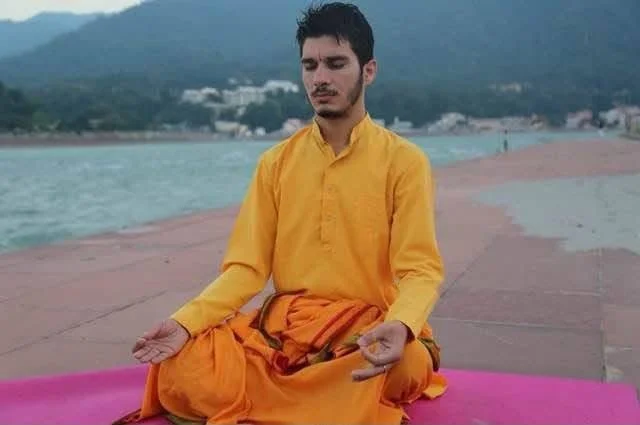
Picture: My formative years at Parmartha Niketan Gurukul in Rishikesh - being aware of our breath was the initial lesson we were taught.
The Yoga Sutras of Patanjali, the most rigorously systematized classical text on yoga, describes a path of eight limbs — Ashtanga. Asana, physical posture, is the third. It is preceded by Yama, ethical restraints, and Niyama, personal observances — the moral and inner ground without which no practice can take root. And it is followed immediately by the fourth limb: Pranayama, the conscious regulation and expansion of the breath.Let me mention here, if you’re new to this and want somewhere concrete to start, we have written a full guide on diaphragmatic breathing. It is usually the first technical shift I ask new students to make before anything else.
Patanjali's definition of asana is itself quietly revolutionary for anyone expecting instruction on alignment: "sthira sukham asanam स्थिरसुखमासनम्" — a posture that is steady and at ease. No particular shape. No specific angle. The purpose of the posture, in this understanding, is to create a stable and quiet container so that the breath can be encountered with full attention. The body is not the destination. It is all about preparation.
In the 15th-century Hatha Yoga Pradipika, written by Swami Swatmarama, the link between breath and mind is made clear. It remained within me through every year of teaching: “When the breath wanders, the mind is unsteady. But when the breath is calmed, the mind too will be still." I do feel this within me. This is what I see in my students. It is not just a philosophy. It’s a fact that can be observed.
Shri Bhagavad Gita, which has influenced my understanding of yoga so much that now I see it as a way of living rather than a way of exercising, states this: "Yogah karmasu kaushalam योगः कर्मसु कौशलम्“ (Chapter 2, Verse 50) — yoga is skill in action. Not mastery of posture. Skill in action, cultivated from the inside, sustained by awareness, rooted — always — in the breath.
Every classical text arrives at the same conclusion:
yoga is an inner science. The body is its laboratory. The breath is its instrument. And the self — not the flexible self, not the performing self, but the witnessing, awake self — is its true subject.
Where I Believe We Have Strayed
I have to be careful here, since I don't believe the modern yoga world has gone wrong due to carelessness or cynicism. The majority of teachers I have encountered are really interested in teaching and really want to be of service to their students. The issue isn't sincerity. The issue is inheritance - we've passed on a practice devoid of its rich context.
If breathing is no longer the basis of movement but merely an accessory to it? Something subtle yet important has changed. The practice becomes external. It becomes measurable in the wrong ways — by how deep the forward fold goes, by how long the handstand holds, by how many classes per week, by how many certified hours. And the anxiety that drove many people to yoga in the first place can quietly migrate inside the practice itself (incidentally, this is exactly the pattern I unpacked in a piece on yoga pranayama for burnout - why breathwork reaches a kind of exhaustion that asana simply can’t touch). I have seen this. Students who come to yoga exhausted by the performance of their lives and find, without realizing it, that they have simply begun performing yoga instead.
The classical tradition anticipated this trap. That is precisely why it placed breath not as a technique among other techniques, but as a philosophy. Breath is the most honest thing about us. It is the one function that is both voluntary and involuntary — we can control it, and yet it continues without us. It lives at the exact border between who we think we are and who we actually are. To truly sit with the breath is to sit at the most unguarded edge of human experience.
This is what I was taught. This is what I try to teach.
Real yoga does not begin when you step onto the mat. It begins the moment you notice — truly notice — that you are breathing.
What Parmartha Niketan Ashram and the Gurukul Gave Me
I studied and lived within the Gurukul tradition at Parmartha Niketan Ashram in Rishikesh — and I want to explain what that means, because the word "Gurukul" has become somewhat exotic in modern usage, when in fact it describes something very simple and very profound.
Guru means teacher. Kula means family, household, clan. Gurukul is not a school. It is a home. A student lives in a Gurukul as a part of a community of practice with the teacher. Every aspect of their daily life is structured by a community of practice:
At what time does a student wake up
How a student begins their morning
What a student eats
How a student studies
How a student serves
How a student rests
In this system, knowledge is not imparted through lectures and is not evaluated using exams. It is transmitted through sustained proximity… Through observation… Through the slow accumulation of understanding that only time and relationship can build. There is no shortcut. There is no accelerated path. The tradition itself is the teaching.
Parmartha Niketan Ashram holds this tradition with extraordinary care. Situated on the banks of the Ganges in Rishikesh — the city the world has long recognized as the spiritual heartland of yoga — the Ashram is a place where the practice is not performed for visitors, but lived by community. The Gurukul did not fast-track me toward a qualification. It asked me, again and again, to slow down. To sit. To observe. To unlearn the habits of urgency that I had arrived with.
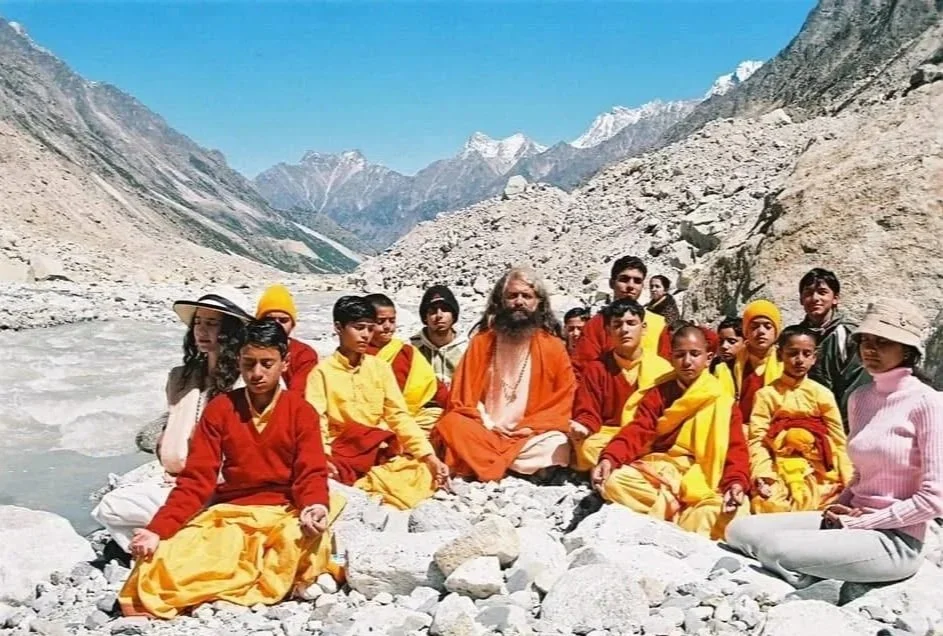
Picture - Our education in the Gurukul is like being on a journey with our Gurus
What I received there cannot be summarized in a curriculum. But if I were to name the single most important thing — the understanding that has shaped every class I have taught, every student I have sat with — it is this:
a teacher's first responsibility is not to instruct a student in the shape of a pose. It is to help that student arrive. Arrive in the body. Arrive in the breath. Arrive in this moment. Because a student who has not arrived cannot truly receive anything, no matter how precise the instruction.
Why the Ordering of Morning Practice Changed Me
Every morning at the Ashram began the same way. Not with a warm-up. Not with Sun Salutations. With Pranayama — seated, still, breath as the first and only object of attention before the body was asked to do anything else.
This ordering is not incidental. I came to understand it as pedagogically precise in a way that years of yoga education outside the Gurukul might never teach. It establishes, from the very first waking moment, a hierarchy of attention: what matters most is invisible. What is most real cannot be photographed or demonstrated. What yoga moves toward is not flexibility or strength or even calm — it moves toward the one who is breathing.
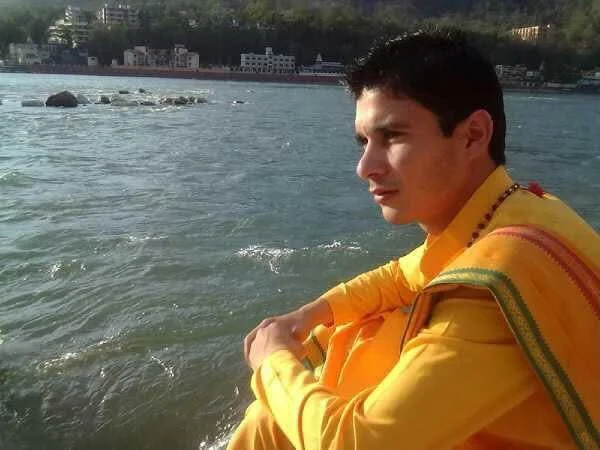
Picture: Mother Ganga is perhaps our greatest teacher at Rishikesh
When you begin with breath, you begin with truth. When you begin with asana, you begin with the surface and hope to reach the depth. Sometimes you do. More often, you remain on the surface, having worked very hard and gone nowhere essential.
I do not say this to disparage the surface. The body is sacred. Movement is sacred (we have recently written about this side of things too - detox yoga and cleansing. It also tells about asanas I turn to when the body itself needs tending, not just breath). But the direction of travel matters enormously. And the classical tradition, with centuries of accumulated wisdom, has always said: go inward first. Begin with breath. Let the body follow what the breath reveals.
Letting This Truth Settle in You
I have noticed something over the years of teaching — something that happens when a student genuinely understands, for the first time, that yoga begins with breath rather than posture. There is a kind of quiet shift. A rearrangement of priorities that is not dramatic but is real. They stop trying to achieve a pose and begin to inquire into who is attempting it. They stop waiting to "feel better" after class and start noticing what happens to the mind when the breath softens — not later, but right now.
In classical tradition, what opens up through sincere pranayama practice has a name: Pratyahara. It’s the withdrawal of the senses. Patanjali placed it as the 5th limb. And what I learned in the Gurukul is that it is not something you force or manufacture. It simply arrives on its own when the breath is given the attention it asks for. The noise of the outer world softens. Not because we have shut it out, but because we have simply stopped being pulled by it.
This is not esoteric. It is available to every human being who has ever breathed consciously — which means it is available to all of us, right now, in this very moment. What is required is not advanced practice or years of experience. What is required is willingness: to begin where the tradition says to begin.
This is an Invitation, Not a Correction
If you have found yoga through a studio, a YouTube channel, a wellness retreat, a fitness class — please hear me when I say that I honor your practice. Truly. Every moment of conscious movement, every pause taken to notice the breath, every time a person chooses stillness over noise — something genuine is happening. None of that is wasted.
But if you have ever felt — as I believe many sincere practitioners feel — that your practice is pointing toward something it hasn't quite reached, a depth you sense but cannot name, I want you to trust that feeling. It is not a judgment of where you are. It is an intimation of where yoga can take you.
The classical tradition has a name for that destination too. Patanjali calls it Samadhi — complete absorption, union with what is most real. He describes it as the natural and inevitable flowering of the entire eightfold path, practiced with sincerity and sustained over time. It does not begin with an advanced asana. It does not require a particular body or a particular lineage. It begins with a single, conscious breath — and the willingness to stay with it.
That is what Parmartha Niketan Ashram and the Gurukul gave me. Not a set of techniques, but a way of beginning. Every day. Every class. Every breath.
Yoga was never meant to be something you do three times a week. It was always meant to be something you are — breathing, present, awake, alive to what is actually here.
And that — only ever that — begins with the breath.
If any of this stirred something in you - like a sense that your practice has more waiting beneath it - I’ve put together a pranayama and breathwork suite of courses that walks through this ordering step by step. Exactly the way it was given to me! Consider it an open door. Not a transaction.
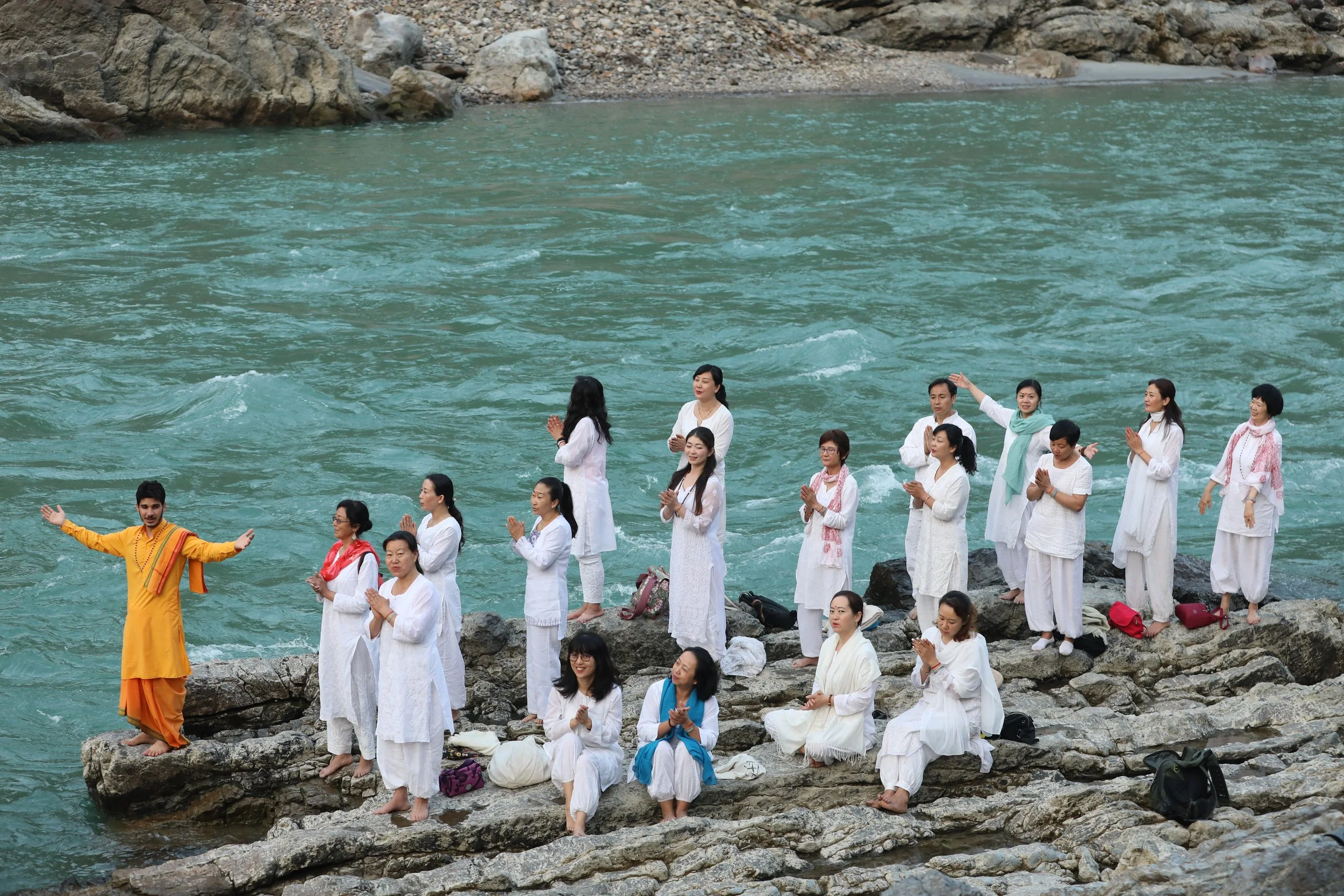
Picture: Let this be an invitation from the land of Ganga & Himalaya to connect with yourself
Namaste! I am Manohar, a yoga teacher and student of the classical tradition. My years of residential education and practice within the Gurukul at Parmartha Niketan Ashram in Rishikesh, India, shaped everything I understand about yoga — not as exercise or performance, but as an inner science of breath, awareness, and the self. I teach with the hope of passing on not just techniques, but the living thread of a tradition that has always known where yoga truly begins.This reflection is part of a series in which I contemplate my experience with the classical foundations of yoga — what the tradition actually teaches, and how we might find our way back to its depth. The next piece asks: If Real Yoga Begins at Breath, Where Does Mantra Sadhana Belong?
If something in these words has reached you and you would like to explore what classical yoga looks and feels like in practice, I warmly invite you to connect. We begin, always, with the breath.