Shiva-Shakti शिव-शक्ति: Balancing Masculine and Feminine Energy Through Mantra Sadhna
Reading Time: 9 minutes
Much of the contemporary wellness content treats "masculine energy" and "feminine energy" as a spectrum you're supposed to balance, like a dial you turn between action and receptivity, structure and flow. That framework isn't wrong exactly, but it's a modern simplification of something the Hindu tantric tradition worked out with a lot more precision, thousands of years earlier, through the relationship between Shiva and Shakti.
· · ─ ·☽𖤓☾· ─ · ·
Shiva And Shakti Are Not Two: They're One, Described Two Ways
Let’s clear up one thing that trips up almost everyone new to this tradition: Shiva and Shakti were never a couple. Not in the way Western mythology hands us couples - two separate beings who fall in love, argue, reconcile, exist apart from each other. There’s no romance plot here. No divine timeline where two beings find each other. They’re traditionally understood as two aspects of a single, undivided reality - Shiva is pure, unmoving consciousness. And Shakti is the dynamic energy that moves through that consciousness and turns it into an actual, living world.
Neither one is complete without the other, and neither one is "in charge" of the other. Consciousness without energy to express itself is inert - teaching image is shava शव, a corpse. Energy without consciousness to move through has no direction or awareness. The tradition's core claim is that you, and everything around you, are already both - awareness and energy moving through it, simultaneously, all the time.
Ardhanarishvara: The Image That Makes This Literal
If you want proof that this isn’t just poetic language, look at Ardhanarishvara अर्धनारीश्वर. One deity, split clean down the middle - half-Shiva, half-Parvati (Shakti). Fused into a single standing figure. It's a symbol that they were never actually separate, and the "two" appearance is the illusion, not the underlying reality.
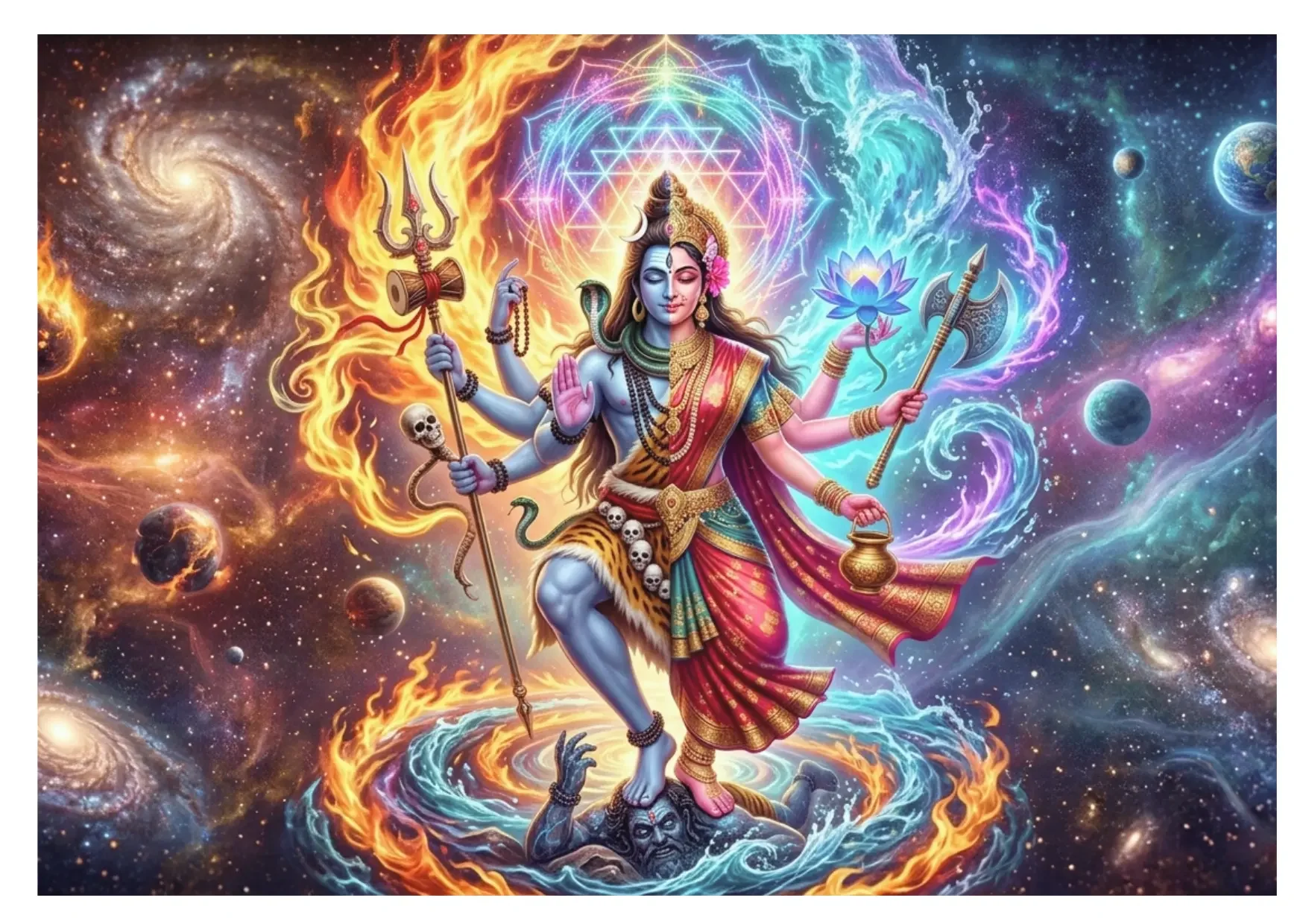
Figure: A contemporary representation of Ardhanarishwar - half Shiva, half-Parvati, embodiment of the divine masculine and divine feminine.
This is worth ruminating on if you've spent time in contemporary and colloquial "divine masculine / divine feminine" frameworks: those frameworks often present masculine and feminine as complementary opposites that need to find balance with each other, like two ends of a scale. If you have ever wanted the fuller picture of what Shakti actually is beneath all the wellness space shorthand, we unpack that properly in this blog we wrote on divine feminine.
Ardhanarishvara proposes something stronger - that the appearance of Shiva & Shakti as two complementary halves is already a kind of misperception, and the deeper truth is a single, whole reality that only looks divided from where we're standing.
Why This Isn't Just Philosophy - It's a Body Practice
In tantric and yogic tradition, Shiva-Shakti relationship doesn’t stay up in realm of cosmic ideas - it gets mapped straight onto your body. Kundalini Shakti कुण्डलिनी शक्ति, the dormant feminine energy said to rest coiled at the base of the spine, rises through the body's subtle energy channels toward the crown where Shiva - as pure consciousness - is waiting. Spiritual awakening, in this model, is quite literally Shakti rising to meet Shiva - energy and awareness waking up to the fact they were one all along!
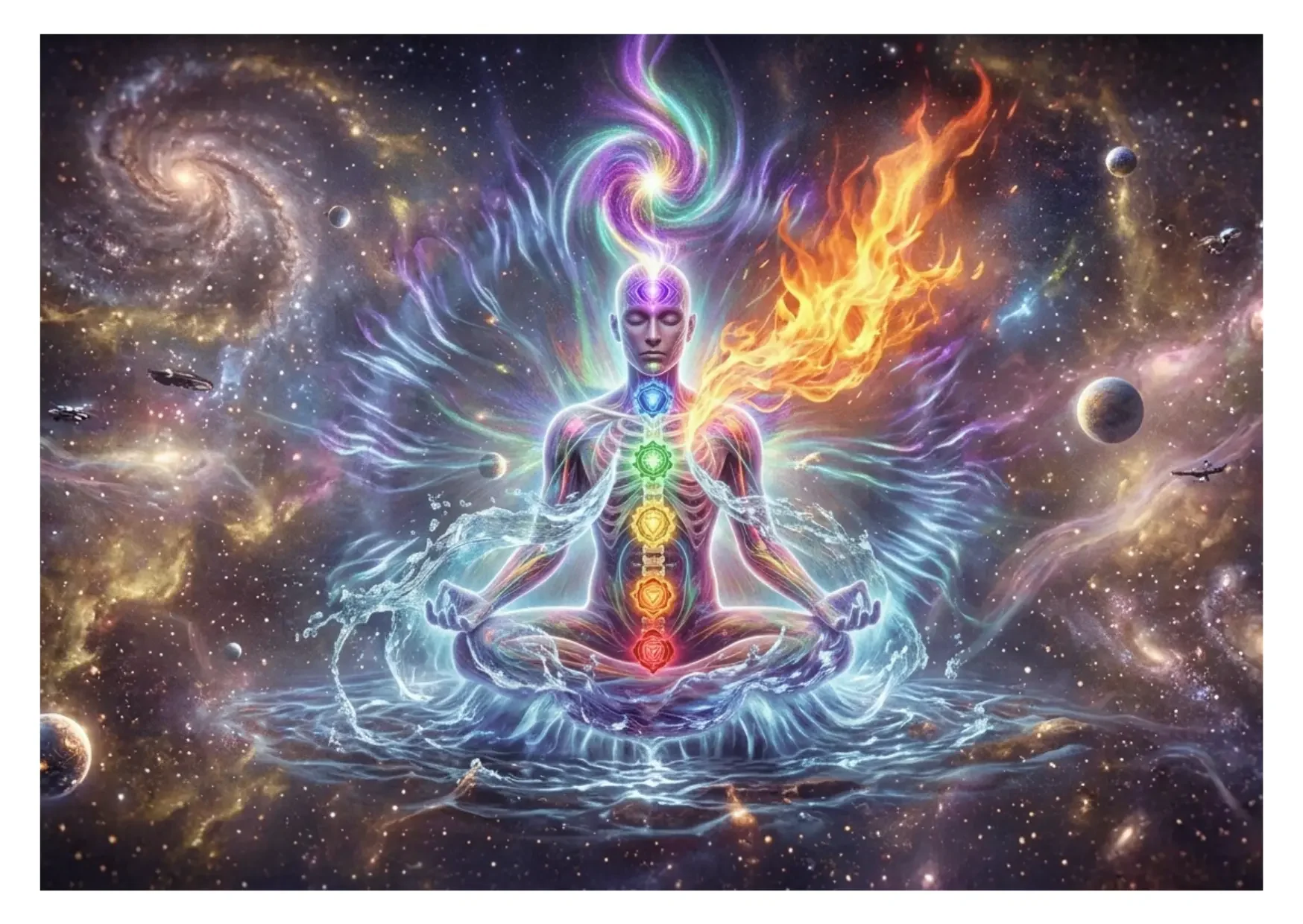
Figure: Kundalini Shakti rises from Muldhara chakra at the base of the spine to meet pure consciousness at the Sahasrara chakra located at the crown
This is also why so much of tantric and kundalini yoga practice - breathwork, mantra, specific postures, meditation - exists: not to "achieve" a masculine-feminine balance from scratch but to remove blockages preventing you from recognizing a wholeness the tradition says was never actually broken.
Chants for Shiva-Shakti Balance
The two chants below are examples of invocations, one addressed to Shiva, one to Devi. They are traditionally used together to work both sides of this pairing in the same sitting. Curious why chanting produces the effect it does - not just spiritually but in body and nervous system as well? We’ve gone deep into that question separately in Science of Mantra!
Shiva 𖤓
ॐ त्र्यम्बकं यजामहे सुगन्धिं पुष्टिवर्धनम्।
उर्वारुकमिव बन्धनान् मृत्योर्मुक्षीय मामृतात्॥
Om Tryambakam Yajāmahe Sugandhim Puṣṭivardhanam, Urvārukamiva Bandhanān Mṛtyor Mukṣīya Māmṛtāt.
Meaning: We worship the three-eyed Lord Shiva who nourishes and sustains all beings, fragrant with virtue. Just as ripe cucumber falls easily away from its vine, may He liberate us from death. Not by cutting us off but by binding us not immortality instead.
The Mahamrityunjaya Mantra is one of the most powerful and revered mantras in Sanatan Dharma. A mantra to Lord Shiva as the one who conquers death itself. Found in the Rigveda, it’s chanted for healing, protection, and freedom from fear of death. Calling on Shiva's grace for grant health, peace, and ultimately moksha (liberation).
Devi (Shakti) ⏾
या देवी सर्वभूतेषु विष्णुमायेति शब्दिता । नमस्तस्यै नमस्तस्यै नमस्तस्यै नमो नमः ॥
Yā devī sarvabhūteṣu viṣṇumāyeti śabditā, namastasyai namastasyai namastasyai namo namaḥ.
Meaning: To that Devi who dwells within all beings, known by the name Vishnumaya (the great power itself) - salutations to her, salutations to her, salutations to her, again and again, salutations.
This verse comes from the Devi Mahatmya's own hymn to the Goddess, and it's the first in a well-known refrain that continues by naming her as the power in intelligence, sleep, hunger, and forgiveness. The same claim explored in our companion piece on the Devi Suktam: that Devi isn't only cosmic force but animating presence inside ordinary experience itself.
A Practical Sequencing Approach
A traditional method for working with both chants in one sitting: begin with the Shiva invocation to settle and steady the mind (the consciousness/witnessing quality), then move into the Devi verse to recognize the same presence as the active, animating power within all things — and close by returning briefly to stillness, mirroring the rise-and-return pattern the tradition associates with Kundalini practice itself.
What "Balance" Actually Means Here
If you came to this looking for a self-help framework — "get in touch with your masculine side, get in touch with your feminine side" — it's worth being precise about what the tradition is actually claiming, because it's a more interesting (and more demanding) idea than a personality-balance concept. It’s also worth naming how much noise sits around this topic right now. We go into that gap directly in why you should know the sacred feminine:
Balance, in the Shiva-Shakti framework, doesn't mean blending two different qualities into a moderate middle. It means recognizing that stillness and movement, awareness and action, structure and flow, were never actually two competing forces to negotiate between — they're a single reality you're already made of, and practice is how you stop experiencing them as divided.
That reframe matters practically: it's the difference between "I need to work on being more assertive" (a personality project) and "the part of me that acts and the part of me that's aware are not actually in conflict, and my practice is remembering that" (an ongoing recognition practice, not a self-improvement checklist).
If "Men are from Mars, Women are from Venus" has ever felt true to you — like men and women are simply wired for different operating systems, one cold, one hot, each speaking a language the other has to learn to translate — the Shiva-Shakti framework isn't offering a gentler version of that idea. It's rejecting the premise entirely. There aren't two planets here. There's one: Earth — fertile, receptive, alive, conscious, giving, all at once, all the same ground. "Masculine" and "feminine" were never two separate worlds sending signals across space to each other. They're what one whole world looks like, described from two different angles.
This isn't just a convenient metaphor — the tradition already makes the same move. Earth herself is understood as a form of Shakti: Bhoomi Devi (also called Prithvi), the earth goddess who bears, feeds, and sustains everything on her without exception. She isn't earth as inert material — the ground you happen to be standing on — she's earth as living, conscious presence, which is precisely the point the "two planets" framework misses.
Where This Connects to Navratri
Navratri, structurally, gives you a full nine-night arc through Shakti's many expressions — grounding, discipline, creative power, protective love, righteous confrontation, release, purification, and finally spiritual completion.. Practicing that arc with a steady Shiva-consciousness underneath it — rather than getting swept purely into Shakti's dynamism without an anchor — is precisely the kind of integrated practice this article is describing.
This is part of why our Navratri Mantra Sadhna retreat doesn't just hand you nine mantras in isolation — the container itself is built to hold both sides: consistent grounding practice each night alongside the active, energizing Devi mantra for that night's form, so you're practicing integration, not just intensity. If the Shiva-Shakti framework in this article resonated with you, Navratri is a genuinely well-suited place to put it into practice rather than leave it as an interesting idea.
The Reframe, in One Line
You are not a masculine side and a feminine side working out a truce. You're one field of awareness and energy that only looks divided — and the traditional practices connected to Shiva and Shakti exist to help you feel that, not just understand it.
☾𖤓☽
This article is Part 3 of a six-part series on Shakti and Divine Feminine Philosophy, unpacking what Shakti actually means as the animating force behind the Divine Feminine. Explore the full series: Part 1 – Why You Should Know the Sacred Feminine — And Why Mahadevi Matters More Now Than Ever ➳ Part 2 – What Is Shakti? The Divine Feminine, Explained ➳ Part 3 – Shiva-Shakti: Balancing Masculine and Feminine Energy Through Mantra ➳ Part 4 – Sacred Feminine Energy: Mantras Connected to Devi and the Divine Feminine Traditions ➳ Part 5 – Durga Isn't a Deity to Worship From a Distance — She's an Energy You Practice With ➳ Part 6 – The 9 Forms of Durga (Navadurga) and the Mantra for Each Night.
Do you notice more Shiva (stillness/awareness) or more Shakti (energy/movement) in your own practice lately? What brought you into better balance?
Our Approach, at Ekattva Yogshala
Everything we teach and practice at Ekattva Yogshala is rooted in tradition — in lineage, heritage, and classical method. We don't deviate from it, simplify it into something unrecognizable, or blend it with whatever happens to be trending. Mantra sadhna in particular carries real nuance: not every mantra is meant for every practitioner, every stage of life, or every circumstance, and getting that wrong isn't a small detail — it's the difference between a practice that works and one that doesn't. Part of our responsibility as teachers is knowing that nuance well enough to guide you through it, which is why we select and teach mantras that can be practiced by anyone, regardless of age, gender, or life situation, rather than offering something that only works in theory.
If you have questions or concerns about anything we teach, we welcome them — reach out any time.