Krishna, the Eternal Friend Who Refuses to Grow Old
A humble offering on the eve of Janmashtami 🦚
Today, at midnight, somewhere a bell will ring. A conch will sound. And a small clay lamp will flicker in front of a cradle, the way it has for longer than anyone can properly trace. This is how it has happened for thousands of years. Not because history demands it, but because love does. Janmashtami is not merely a date on the calendar. It is the day the heart of Bharat remembers that God once chose to be born in a prison cell, in the middle of a storm, in the dead of night — and smiled anyway.
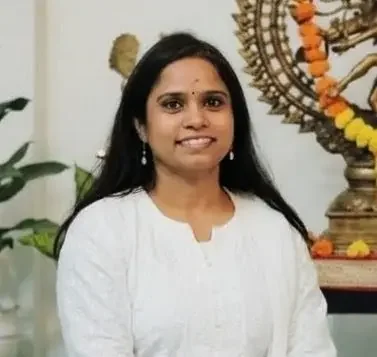
I write this not as a scholar but as a poetess, as a lover writes of the Beloved. Forgive me if devotion spills over the edges of reason here and there. That quality of being beyond logic, after all, is the way of love. One can attempt to feel Krishna only through love.
The God Who Laughed
What strikes us most about Krishna isn’t his divinity. It’s his utter refusal to be solemn about it. Here’s a God who steals butter. Who dances with the cowherd women under the moon. Who teases, who flirts, who plays the flute so sweetly that rivers are said to have paused their own flow just to listen. There's something to that image beyond poetry, actually - we've written before about why Om sound itself, not just meaning, has always been treated as sacred in this tradition. Other traditions ask us to approach the divine with folded hands and lowered eyes, with renunciation. Krishna on the contrary, asks us for something else entirely - he asks us to be involved without being attached, not give up but ask with an open heart and, if you can manage it, a little mischief tucked inside that heart too!
This is his first teaching actually. Given long before he ever spoke a word of philosophy: divinity was never opposed to joy. You don’t need to renounce laughter to reach God. You only need to love enough that the laughter becomes an offering.
Why He Comes, Again and Again
Krishna himself explains why he descends at all. Not once but again and again. In every age that needs him.
यदा यदा हि धर्मस्य ग्लानिर्भवति भारत । अभ्युत्थानमधर्मस्य तदात्मानं सृजाम्यहम् ॥
परित्राणाय साधूनां विनाशाय च दुष्कृताम् । धर्मसंस्थापनार्थाय सम्भवामि युगे युगे ॥
Yada yada hi dharmasya glanir bhavati bharata
Abhyutthanam adharmasya tadatmanam srijamy aham
Paritranaya sadhunam vinashaya cha dushkritam
Dharma-samsthapanarthaya sambhavami yuge yuge
Whenever righteousness weakens and unrighteousness rises, Krishna says, he creates himself. Age after age. To protect the good, to dissolve the harmful, to re-establish balance wherever it’s slipped.
You noticed what he doesn’t say here? He never said he would come once. To a single person. In a single century. And then quietly retire into history. He says yuge yuge. Age after age. Which means every generation watching its own dharma erode gets to ask, quietly, whether this is one of those moments. I suspect ours is.
The Ancient Charioteer Who Speaks to Every Age
And yet the same Krishna who danced as a child stood, years later, as a charioteer on the battlefield of Kurukshetra. He delivered words that have outlived empires since. The Bhagavad Gita is not a sermon frozen somewhere in the past. It’s disturbingly, almost uncomfortably contemporary.
Arjuna's crisis was never really about war. It was about paralysis. The very modern sickness of knowing exactly what needs to be done and somehow being unable to move anyway. Krishna's response wasn’t to soothe Arjuna with comfort. It was to wake him up with clarity. Starting with the question of identity itself:
न जायते म्रियते वा कदाचि-न्नायं भूत्वा भविता वा न भूयः।
अजो नित्यः शाश्वतोऽयं पुराणो न हन्यते हन्यमाने शरीरे ॥
Na jayate mriyate va kadachin
Nayam bhutva bhavita va na bhuyah
Ajo nityah shashvato 'yam purano
Na hanyate hanyamane sharire
Krishna tells him that the self is never born and never dies. It doesn’t come into being and then ceases to be. Unborn. Eternal. Ever-abiding. Ancient. It isn’t slain when the body is slain. Before Krishna offers a single word of strategy for the battlefield ahead, he first relocates Arjuna's entire sense of self away from the fragile, temporary body and toward something circumstance simply can’t wound.
Only then does the practical counsel finally arrive: act but don’t cling to the fruit of that action. Find steadiness in a world that will never stop shaking.
Tell me this is not the medicine our century needs. We live inside an economy of anxiety — anxious about outcomes, addicted to results, exhausted by the tyranny of "what if." And here, in second chapter of the Gita, Krishna gives Arjuna (and anyone willing to receive) the single most quoted, most needed verse of the entire text:
कर्मण्येवाधिकारस्ते मा फलेषु कदाचन।
मा कर्मफलहेतुर्भूर्मा ते सङ्गोऽस्त्वकर्मणि॥
Karmanye vadhikaraste ma phaleshu kadachana
Ma karma-phala-hetur bhur ma te sango 'stv akarmani
You have a right to your actions, Krishna says. Never to the fruits those actions produce. Don’t let the result become your motive. And don’t let fear of that result stall you from acting at all. It is one sentence, and it dismantles the entire architecture of modern anxiety. We are not anxious because we work too hard — we are anxious because we have quietly made the outcome our god instead of the offering. Krishna asks us to reverse that, gently but firmly.
This is nishkama karma — action without the frantic grip of attachment — and it is not ancient wisdom gathering dust. It's the same distinction we come back to often in mantra sadhana practice, actually. Real sadhana was never meant to be a passive belief you hold onto, but something you actually do, deliberately, without grasping at the outcome. It is a working manual for anyone drowning in notifications, deadlines, and the endless performance of modern life. The world does not need Krishna because he is old-fashioned. The world needs Krishna because he is increasingly becoming not just more relevant, but essential.
Why the World Must Know Him
We are, all of us, Arjunas — standing on our own battlefields of career and conscience, family and fear, doubt and duty — asking some version of his question: what am I supposed to do, and who am I, really, underneath all of this?
Krishna does not hand us a rulebook. He hands us a relationship. He says: bring me your confusion, your fear, even your anger — I am not afraid of your humanity. This is why the world needs to understand him — not as a mythological figure confined to a religion or a region, but as a living philosophy of engaged, joyful, fearless living. In an age of extremism and exhaustion, Krishna's balance — the warrior who plays the flute, the statesman who is also a lover, the philosopher who is also a friend — is a rare and necessary wholeness.
Meera's Madness, and Ours
If Krishna is the answer, Meera Bai is the proof of what happens when someone truly hears the question. A princess who walked away from a palace for a love our world called madness. She drank poison, they say. And guess what? It turned to nectar in her hands. Because by then, devotion had already dissolved whatever boundary once stood between her life and his. Meera did not worship Krishna from a distance. She loved him (recklessly, publicly, scandalously) the way only a Gopi or a poet can.
Every devotee carries a little of Meera's madness. When we truly love Krishna, we stop performing piety and start becoming a little unreasonable — a little too joyful, a little too surrendered, a little too in love to explain ourselves to a world that only trusts what is measured and safe.
Osho's Provocation
And then there is Osho, who — however one judges the rest of his life — understood something essential about Krishna that many pious commentators miss: Krishna is whole precisely because he refuses to fragment himself. Osho called Krishna the only fully orchestrated man. A being in whom the warrior and lover, philosopher and dancer, were never actually at war with each other.
Most of us are taught to choose. Be spiritual or be alive. Be disciplined or be joyful. Be strong or be soft. Krishna simply never got that memo. He’s proof if you need it, that wholeness (not renunciation) might be the deepest spirituality there is. This is close to the same idea underneath Shakti - the divine feminine herself. A power that refuses to be reduced to one quality, one mood, one fragment of what she actually is.
An Offering
Near the very end of the Gita, after eighteen chapters of philosophy, warfare, and cosmic vision, Krishna offers his final and most tender instruction. Not a doctrine. An embrace.
सर्वधर्मान्परित्यज्य मामेकं शरणं व्रज।
अहं त्वां सर्वपापेभ्यो मोक्षयिष्यामि मा शुचः॥
Sarva-dharman parityajya mam ekam sharanam vraja
Aham tva sarva-papebhyo mokshayishyami ma suchah
Abandon every other refuge, he says, and come to me alone. I will free you from all that binds you — do not grieve. After every argument, every teaching, every proof, this is where he lands: not with a rule to follow, but with an open hand. This, I think, is the truest thing about him. Krishna does not want our perfection. He wants our surrender — offered honestly, even imperfectly, even today.
Krishna and Janmashtami: Final Words
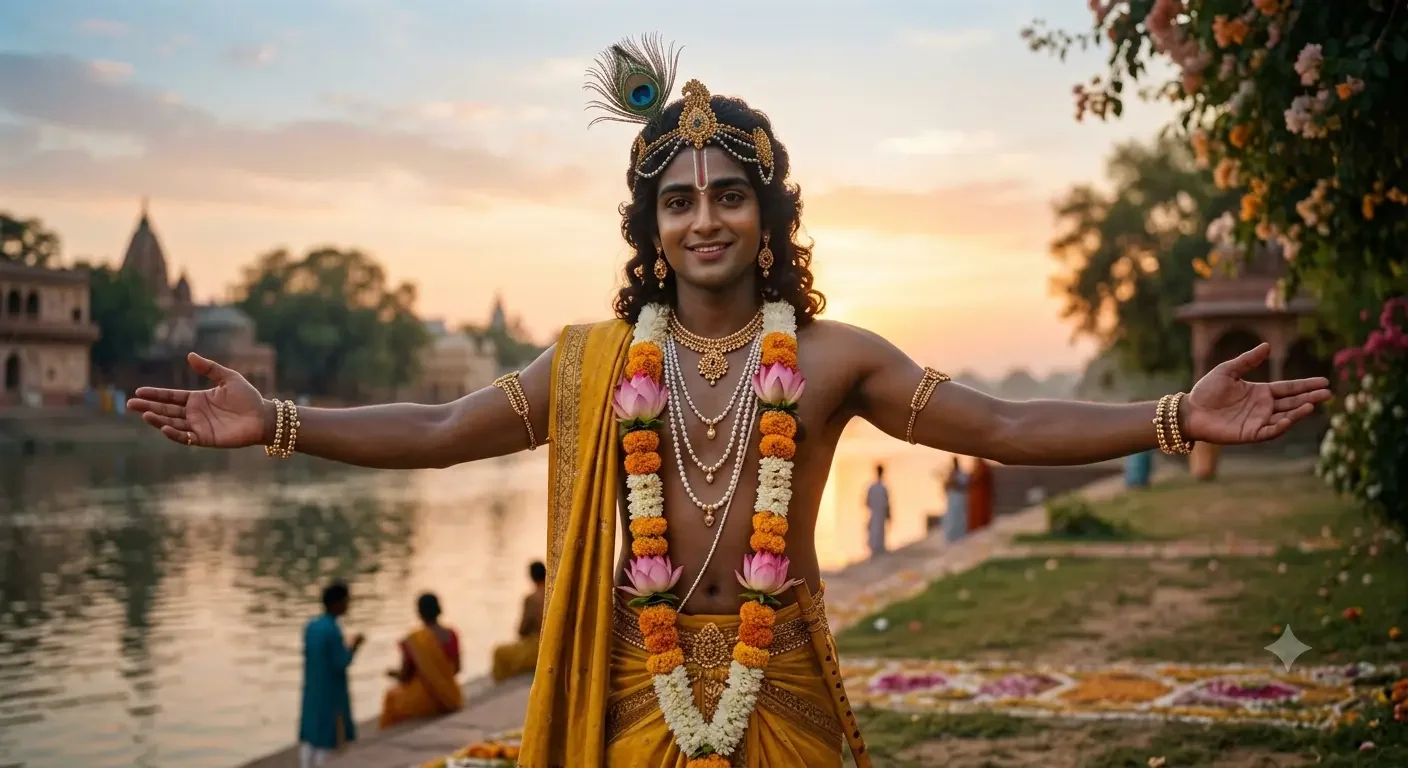
So tonight, when lamps are lit and cradle is rocked at midnight, I won’t just be remembering a birth that happened probably 5000 years ago. I’ll be remembering an invitation that’s still open right now, to anyone willing to take it. To live fully. To love recklessly. To act without clinging and surrender without shame. And somewhere in all of that, to find the flute-song hidden inside even our hardest battles.
Happy Janmashtami. May Krishna, in whatever form he chooses to visit you — as philosopher, as friend, as impossible, irresistible love — dance a little mischief into your life this year.
Radhe Krishna. 🪈
How do you relate to Krishna, if you do? Share with others in comments below, after all goodness is to be shared.
A soulful chant — the Nandakumar Ashtakam, sung by Manohar Prasad, in praise of Krishna's beauty and grace.