Ganesh Chaturthi: Why We Chant to the Remover of Obstacles Before We Begin Anything
Reading Time: 6 Minutes
Every year, right around this time, elephant-headed murtis start appearing on altars, in shop windows, and at the front of yoga studios everywhere. Ganesh Chaturthi — the festival marking Ganesha's birth — is one of the most joyful dates on the Hindu calendar, and one of the most visually recognized. You don't need to know the mythology to know the silhouette: the curved trunk, the round belly, the mouse at his feet. Ganesha is arguably the most familiar Hindu deity in Western spaces — printed on tote bags, tattooed on shoulders, propped on studio shelves next to the essential oils.
That familiarity is a gift. It means most people already have a foothold before they ever learn the philosophy behind it. This post goes one layer deeper — past the image and into the practice — through the mantra that has opened prayers, journeys, and new chapters for centuries.
Who Ganesha Is, Briefly
Ganesha is son of Shiva and Parvati. And in nearly every tradition, he's the deity approached first. Before any other prayer, any other god, any other undertaking. He's known as Vighnaharta - remover of obstacles. And, paradoxically, also as one who can place obstacles in your path when the timing simply isn't right. That duality is the whole point. Ganesha was never a guarantee of smooth sailing. He's a reminder to pause. Get honest about what's actually in your way. And ask for clarity before you charge ahead anyway. It's a similar teaching we return to often - mantra sadhana - that real practice isn't about pushing through resistance but actually pausing long enough to name it first.
Ganesh Chaturthi celebrates his arrival. Homes and communities welcome him in with clay idols, prayer, sweets (modak, his favorite), and music before immersing his idol in water days later. A symbol of the cycle of creation and release, playing out in real time.
Few Facts That Still Astonish
✶ He's reason the Mahabharata exists in written form at all. The sage Vyasa asked Ganesha to be his scribe for the epic on one condition: he could never pause his pen. When his quill broke mid-dictation, Ganesha is said to have snapped off his own tusk and kept writing rather than stop — which is why he's often depicted with a broken tusk, and why that tusk has become a symbol of sacrificing part of yourself for something greater.
✶ His vehicle is a mouse. And that's the point! Ganesha is enormous. His chosen vahana is one of the smallest creatures alive. Pairing says something on its own - no obstacle is too small to sneak past your guard.And no being is too small to carry something vast.
✶ The public festival itself is only about 130 years old. Worship underneath it is far older. Large-scale public celebrations were revived by freedom fighter Bal Gangadhar Tilak in 1893. Turning home-based worship into massive community gatherings that helped unite people against colonial rule. What fills the streets of Mumbai today is both ancient devotion and modern history, layered on top of each other.
✶ His elephant head has more than one origin story. In most famous version, Parvati created Ganesha to guard her privacy while she bathed. When he refused Shiva’s entry, a conflict left him beheaded. And he was restored to life with head of the first creature found - elephant. The story was never really about violence. It's about how Ganesha came to hold two natures at once. Fierce guardian. Gentle protector.
The Mantra: Vakratunda Mahakaya
If you only learn one Ganesha mantra, make it this one! It's short. It's old. And it's meant to be used - not just admired from a distance.
वक्रतुण्ड महाकाय सूर्यकोटि समप्रभ। निर्विघ्नं कुरु मे देव सर्वकार्येषु सर्वदा॥
Vakratunda Mahakaya Suryakoti Samaprabha Nirvighnam Kuru Me Deva Sarva-Karyeshu Sarvada
Rough meaning: "O Lord with the curved trunk, mighty body, radiant as a million suns — please make all my endeavors free of obstacles, always."
It's a request, plainly made: clear the way. No embellishment needed. If you're new to mantra practice altogether, it's worth understanding what actually makes a sound like this work. We've gone deeper into the mechanics elsewhere using Om as the example.
When to Actually Use It
The reason this mantra has survived for centuries isn't nostalgia — it's utility. It's built for three specific moments:
✶ Before starting something new. A new job, a new relationship, a new business, a new creative project, a new year. Vakratunda Mahakaya is traditionally chanted first before any undertaking. So you begin with intention rather than just momentum. Three rounds before you send the email, sign lease, or open laptop.
✶ When you're facing an obstacle. Not hypothetically. Right now, mid-obstacle. This is a mantra for middle of the mess… When you need to name the block honestly and ask for clarity to move through it. Not around it.
✶ At the start of a retreat or practice. Opening a yoga retreat, a meditation intensive, or even your personal practice for week with this chant sets container. Let whatever happens here be free of unnecessary resistance, right from the first breath of it.
You don't need Sanskrit fluency. Nor even a particular tradition to use it. Repetition, intention, moment of stillness - that's genuinely the whole requirement.
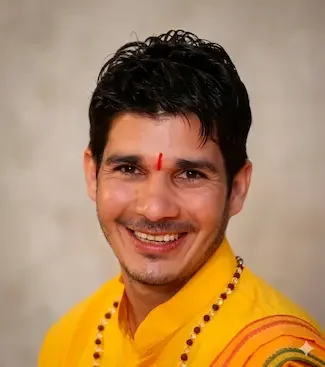
Listen: Vakratunda Mahakaya, Chanted by Manohar Prasad
To mark Ganesh Chaturthi this year, our founder Manohar recorded his own rendition of Vakratunda Mahakaya — the version we'll be turning to before this year's retreats, launches, and everything in between.
Vakratunda Mahakaya — a soulful rendition of the sacred Ganesh Shlok, invoking Lord Ganesha to remove all obstacles and bless new beginnings.
Save it. Play it the next time you're standing at the edge of something new.
What We Can Take From Ganesha
Ganesha's stories endure because they're relational — he's not just a cosmic force, he's a son, a brother, a guardian, a leader. Each role carries something worth sitting with.
✶ As a son. The most famous Ganesha story isn't about obstacles at all - it's about a race. Ganesha and his brother Kartikeya were challenged to circle the universe three times for a prized fruit. Kartikeya took off on his peacock. No hesitation at all.
Ganesha simply walked around his parents three times and declared himself done. Reasoning that Shiva and Parvati were his universe. He won. Sometimes the biggest goal is standing right in front of you.
✶ As a brother. Ganesha and Kartikeya's rivalry is real in the mythology — competitive, occasionally petty, entirely familiar to anyone with siblings. But it never curdles into lasting resentment. You can compete with someone you love and still show up for each other right after.
✶ As a protector. Long before he was a god of wisdom, Ganesha was a guard standing at a door, holding a boundary even against Shiva himself. Protection isn't always dramatic, and it isn't always convenient for the people it inconveniences — sometimes it just means standing firm at the threshold you've been asked to hold.
✶ As a leader. Ganesha's title Ganapati means lord of the ganas. The unruly host of beings who serve Shiva. Leading a crowd like that was never about force. It's about presence and patience. Bringing order without erasing a single one of their natures in process.
✶ As a devotee. The broken-tusk story is also one about showing up fully for a commitment, even when it costs you something — finishing what you started with whatever tools you have left.
Together, these aren't just bedtime-story morals. They're a fairly complete picture of how to move through relationships and responsibility — devotion that doesn't need to be loud, competition without cruelty, boundaries held without apology, and leadership rooted in patience rather than control.
This Ganesh Chaturthi
Whatever "something new" looks like for you this season — a project, a practice, a hard conversation you've been putting off — Ganesh Chaturthi is as good a moment as any to pause and ask for a clear path forward. If Krishna's story resonates with this same spirit of showing up fully, whatever form devotion takes, we wrote about exactly that for Janmashtami not long ago.
Happy Ganesh Chaturthi ✶