Why Visit Rishikesh? The Ganges, Himalayas, and 3,000 Years of Seekers
Reading Time: 5 Minutes
There are places on earth that hold history, and then there are places that hold memory — a kind of accumulated human intention that seems to hang in the air long after the people who built it are gone. Rishikesh is the second kind.
Ask a hundred travelers why they came here and you'll get a hundred different answers. A yoga teacher training. A friend's recommendation. A documentary about the Beatles they half-watched one night and couldn’t stop thinking about. A doctor's suggestion to slow down before something actually breaks.
But underneath every single one of those answers sits the same pull - the sense that this particular stretch of land where the Ganga rushing out of the Himalayas and turns from a mountain river into the river of a civilisation, was built for exactly this kind of searching.
A River That Remembers
The Ganga in Rishikesh isn't a wide, slow river you’ll find further south on the plains. Here, she’s still cold from glacier melt. Still moving with the urgency of the mountains she just left behind. Locals will tell you the water’s character shifts as it travels south - but in Rishikesh, it’s at its most alive. Sit on the ghats at dusk and watch the aarti flames drift downstream in little clay boats. And it’s not hard to understand why this river has been treated as a living goddess for thousands of years, not a resource to be managed. It's the same instinct we've traced back to its actual source elsewhere. This idea that the sacred feminine isn't a metaphor bolted onto nature, but the ground of it
For the seeker, this river was never scenery. It's a teacher. It moves constantly, holds nothing, and reflects whatever light falls on it - three ideas that show up, one way or another, in almost every philosophy taught in this town.
The Hymn That Carries Her Name
Long before "river conservation" entered the vocabulary, devotees had already found their own way of honoring the Ganga. Through SOUND! The Ganga Stotram is one of the oldest, most revered hymns dedicated to the river - traditionally attributed to Adi Shankaracharya, 8th-century philosopher-saint whose own footsteps once passed through this very place.
Composed in Sanskrit, the hymn speaks to the Ganga directly, as a living, compassionate goddess. It celebrates her descent from the heavens. Her power to purify. Her role as a mother to everyone who comes to her banks seeking refuge, healing, or liberation. It's traditionally chanted during aarti and daily worship, its rhythm mirroring the very motion of the water it praises.Do you know there's real science behind why sound moves people this way, not just tradition? Something we've actually gone into in more depth elsewhere in our blog on the science of mantra!
To hear it is to understand something about Rishikesh that's hard to put into words otherwise. Our founder and Chant Master, Manohar Ji, has recorded his own rendition of the Ganga Stotram — a devotional offering in the same spirit as the seekers who've chanted it on these banks for centuries. You can listen to it here: Ganga Stotram, chanted by Manohar Ji.
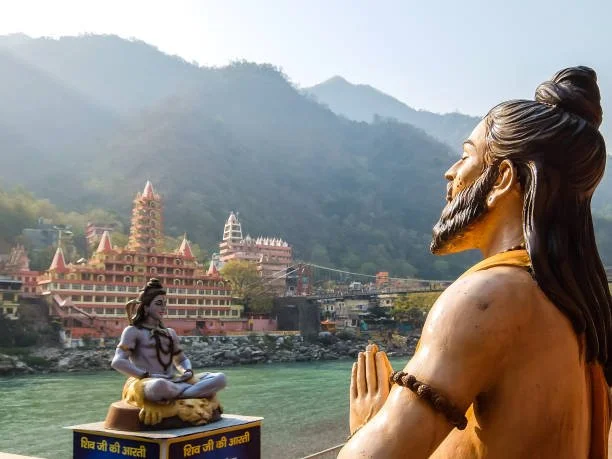
Pristine Ganga river, with Manikoot mountains of Himalayan range in backdrop in Rishikesh is the ideal setting for Yoga. This is every Yogi's dream.
The Himalayas as First Teacher
Rishikesh sits at the literal threshold of the Himalayas - gateway, people call it, to Badrinath and the higher pilgrim routes beyond. You don't need to trek for days to feel that presence either. The foothills alone reshape everything - how sound travels, how light falls in the morning, how quiet nights become once the market stalls close for night.
Yogic and Vedantic traditions have always treated mountains as more than geography. Solitude. Altitude. Silence. These were considered ingredients for clarity long before “digital detox” became a marketing phrase anyone could sell. What Rishikesh offers is a version of that solitude you can actually reach. Not a multi-day expedition into nowhere but a short walk from your guesthouse into forest trails, waterfalls, and the kind of quiet that resets a nervous system without asking anything extreme of you first.
Three Thousand Years of Footsteps
Long before Rishikesh appeared on a yoga retreat brochure, it appeared in scripture. The name itself is tied to sage Raibhya's penance and Lord Vishnu's appearance as "Hrishikesh," lord of the senses — a fitting namesake for a town devoted to mastering exactly that. Adi Shankaracharya is said to have passed through here over a thousand years ago. Countless renunciates since. Wandering sadhus, householders on pilgrimage - they carry nothing more than the reason that brought them.
This is what actually separates Rishikesh from a scenic wellness destination built for the Instagram era. The infrastructure of seeking - ashrams, temples, meditation caves, ghats - was here centuries before international arrivals, and it was built by and for people who had no interest in an audience. This is exactly the tradition our founder writes about from the inside - why real yoga begins at breath, what it actually meant to live and train inside one of these ashrams, long before it had a name for tourists.
That depth doesn't disappear because the town has grown. If anything, it's the reason so many traditions, teachers, and lineages still choose to root themselves here rather than in a more convenient location closer to Delhi.
Yes, It Has Changed — and That's Not the Whole Story
It would be dishonest to pretend Rishikesh is untouched. Tourism has grown fast, sometimes faster than the town's infrastructure could comfortably absorb, and like every major spiritual destination in India — Varanasi, Bodh Gaya, Amritsar — it has weathered its share of overcrowding, commercialization, and the occasional headline that focuses on the worst day rather than the whole story.
None of that erases what's actually here. Walk fifteen minutes off the main Laxman Jhula–Ram Jhula stretch during off-peak hours and you'll find the same forests, the same ashrams running the same dawn practices they've run for decades, the same river. The crowd exists in specific pockets, at specific times of year. The stillness exists everywhere else, all the time — you just have to know when and where to look for it, which is exactly what a well-planned trip solves for.
Why Seekers Still Come
The river and the mountains explain why seekers have always come. What happens once you're actually here is a different, equally old story - why Rishikesh heals and a daily rhythm that shifts with the calendar, from December's austerity to March's communal roar, laid out in our best time to visit Rishikesh. If you're planning to make that journey alone, it's also worth reading is Rishikesh safe for solo travel woman guide before you book.
But underneath the history and the geography sits something quieter and more immediate — a shared table, a fast-forming community, the daily texture of actually living here. That's the part we explore in Why Rishikesh Stays With You, once the history and the geography have done their work of getting you here.
Planning your first trip to Rishikesh? The right season, the right neighborhood, and the right retreat make all the difference between fighting the crowds and finding the stillness this place was always known for.